The System is the Problem
Welcome to Co.—a guide to the new systems humans and machines are building together in an AI-native world.

In 19th-century London, you could make a living knocking on strangers’ windows with a long stick. If this was you, you were a "Knocker-Upper.” Basically, a human alarm clock.
The Industrial Revolution demanded a punctual workforce, but alarm clocks were expensive luxuries. For a few pence a week, a Knocker-Upper guaranteed you'd make it to the factory on time. They were persistent, tapping with a bamboo stick, or even a pea-shooter, until you waved them off from the window.
This profession survived into the 1970s. It wasn't undone by changing laws or a lack of sleepy customers. It was annihilated by a cheap piece of technology: the mechanical alarm clock.
But the Knocker-Uppers didn't vanish quietly. They fought back with arguments that should sound terrifyingly familiar today. They argued they were more reliable than a machine. They offered a human touch. They insisted on their personal guarantee, a promise a cheap tin clock couldn't make. They even adopted new tools to do their old job better.
They were polishing the stick, hoping it would look better in the face of change. It didn’t help. The alarm clock still won.

You Are a Knocker-Upper. You Just Don't Know It Yet.
The Knocker-Upper didn't become obsolete because people stopped needing to wake up. They became obsolete because the fundamental constraint they solved—access to time awareness—was eliminated.
Their fatal mistake wasn't their work ethic. It was their imagination. When the alarm clock appeared, they didn't see a system change; they saw a competitor. So they focused on "value-adds" to compete within a system that was already dead.
This is exactly what many professionals are doing right now.
The fundamental constraint AI annihilates is not "the time it takes to do a task." It is the cost of coordination and cognition. Your professional existence, your workflow, your entire department, is almost certainly an artifact of the high cost of one of these two things.
Let’s name names.
If you're a Project Manager, you're a Knocker-Upper. Your job exists because coordinating between engineering, marketing, and leadership is expensive and fraught with friction. You are the human API for the organization.
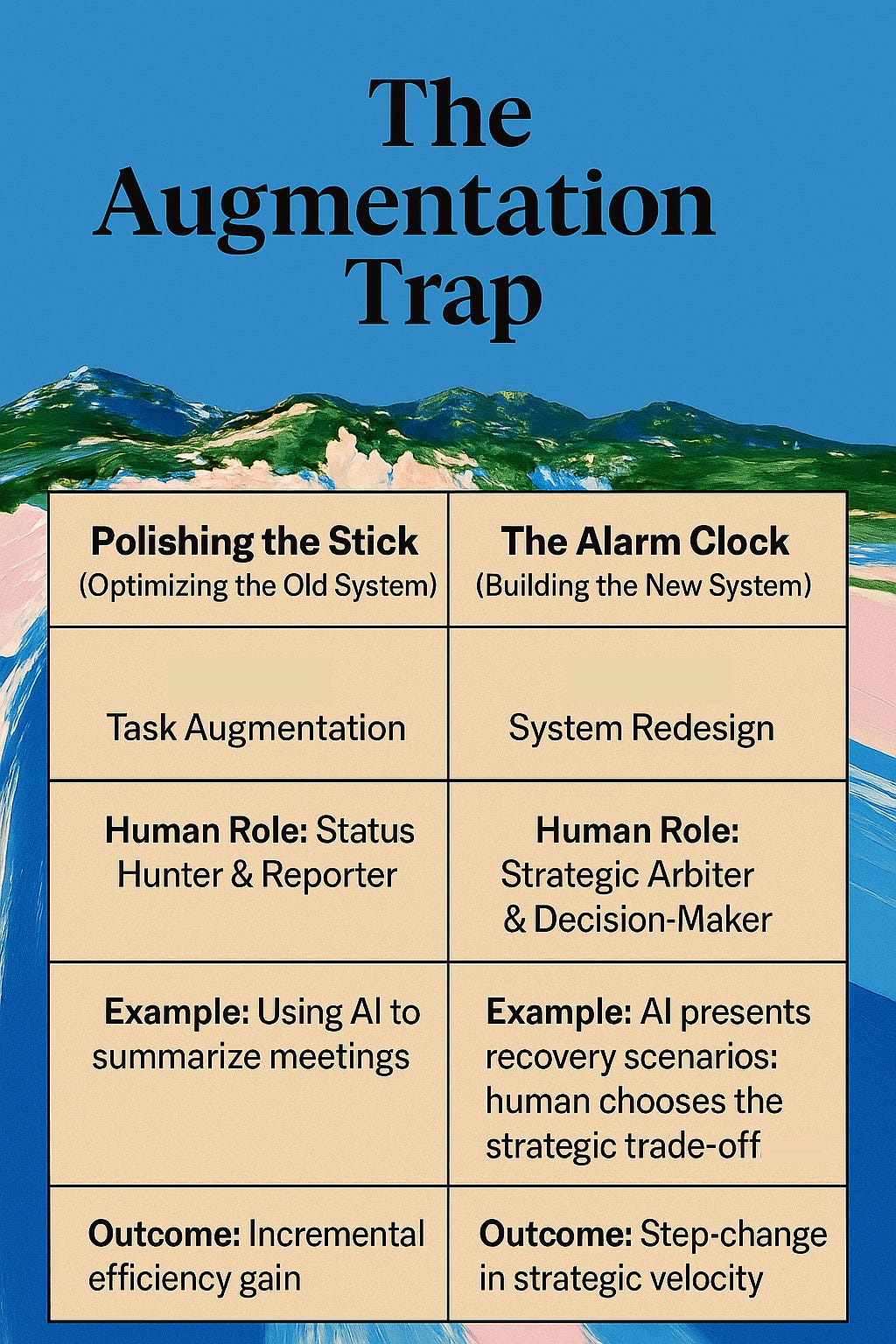
Polishing the Stick: You’re using AI to transcribe your meetings, summarize Slack channels, and draft status updates.
The Alarm Clock: A system that doesn't just report status, it models the future. It ingests real-time progress from code commits and design files. When a delay is detected, it doesn't just flag it—it presents three viable recovery scenarios to leadership, complete with resource trade-offs and impact analysis. The human PM's role shifts from being a "status hunter" to the strategic arbiter who makes the final, high-stakes call on the trade-offs the machine surfaces.
If you're a Marketing Analyst, you're a Knocker-Upper. Your job exists because understanding customer intent from scattered data points is cognitively demanding.
Polishing the Stick: You write SQL faster, summarize dashboards quicker, and crank out decks.
The Alarm Clock:A system where the human sets the strategic objective ("Acquire 1000 new enterprise users in Germany with a max CPA of $400"). The machine then designs and executes hundreds of concurrent campaign experiments, reallocating the budget in real-time. The "insight deck" is replaced by a live dashboard of goal-to-reality tracking. The analyst’s job is no longer finding insights; it’s defining the mission and interrogating the machine’s strategy when outcomes diverge from the objective.
If you're a Corporate Recruiter, you're a Knocker-Upper. Your job exists because hiring is a high-friction, human-gated process.
Polishing the Stick: You use AI to write better job descriptions and screen resumes.
The Alarm Clock: A system where a project's needs automatically generate a “talent request” to a global pool of verified contributors. The AI matches skills to tasks, runs tailored technical assessments, and even negotiates contracts based on predefined parameters. The human recruiter's role is transformed from a “gatekeeper” to a community architect. Nurturing the talent ecosystem, vetting its members, and handling the complex human relationships the machine cannot.
Notice that in every case, the “Alarm Clock” doesn't eliminate the human; it eliminates the low-value, coordinative drudgery, freeing up the human to focus on strategy, judgment, and relationships. Work the machine can't do.
In each case, the illusion is the same: you think you’re augmenting your job. But you’re just optimizing your role in a system that’s already irrelevant.
The provocative question isn’t "How can AI help me do my job?" It’s: "Does this job have any right to exist when its foundational constraint is gone?"
Most people are afraid to ask that question. They prefer to keep polishing the stick.
So what comes next?
This isn't a doomsday prophecy. It's a re-imagining. For every Knocker-Upper who vanished, a new system was born, creating new roles for those who could see them.
The real opportunity is designing what comes after.
This design challenge isn't just about building a more efficient machine. It's about redesigning our own jobs so that we handle the 'why'—the strategy, the goals, the ethics—while the machine handles the 'how'. After all, even the most powerful AI has a massive liability: judgment. Ethics, trust, and strategic oversight aren't features you can code; they are the bedrock of a functional human-machine system.
Co. exists to explore this redesign—across three levels:
Level 1: The Organizations (The Future of Work)
Your org chart is a fossil. It was built to manage the cost of human coordination, designed like a 19th-century army: rigid hierarchies, slow communication up and down the chain of command, and decisions made far from the front lines.
AI annihilates the need for this structure. Instead of a chain of command, it creates a web of intelligence, where information isn't slowly passed up and down. It's instantly available to everyone. Small, empowered teams on the front lines no longer wait for orders. They receive mission objectives and are given the autonomy to execute, backed by a system that coordinates resources for them in real time. Middle management doesn't get streamlined; it evaporates. All that's left is the mission, the team, and the system that binds them.
We’ll explore:
If day-to-day "management" evaporates, what becomes the new work of human "leadership"?
What replaces the “department” when an AI can assemble the perfect, cross-functional team for any project, on demand?
What does “career growth” look like when teams are assembled and dissolved dynamically by intelligent systems?
Level 2: The Systems (The Work Itself)
Most work is a traffic jam of handoffs. The sequence of your tasks is an artifact of old constraints: waiting for an email, for a meeting, for a signature. It’s a workflow designed around human latency.
AI eliminates that latency. But instead of redesigning the system, we are just speeding up the workflows that are causing these traffic jams in the first place.
Consider code reviews: they exist because human memory is fallible and coordination is expensive. But what if AI could provide instant feedback on code quality, security, and team standards as you write? The "review" becomes ambient, continuous, invisible.
We’ll investigate:
When ambient, real-time data makes the status meeting obsolete, what becomes the new venue for team cohesion, debate, and decision-making?
Which cognitive workflows—from legal discovery to medical diagnosis—are fundamentally just pattern-matching engines waiting for a new, automated system?
What happens when you design workflows where humans and machines build together, meaning not just in sequence, but in sync?
Level 3: The Tools (The Human-AI Interface)
Let's be honest: our software is fundamentally stupid. It has no goals and no initiative; it just sits there, waiting for the next explicit command.
AI-native tools don’t have to be passive command-line servants; they can be proactive creative partners.
Think about how Figma changed design. Not by making Photoshop faster, but by making design collaborative and system-based. The next wave of tools will make human-AI collaboration feel just as natural, moving from explicit commands to shared intent.
We’ll feature the people building and testing these frontier interfaces:
What happens when your tools know your goals before you do?
How do we design for collaboration instead of command?
When a machine can generate 1,000 designs in a second, what is the human's role? Strategist? Curator? Taste-maker? Ethicist?
Introducing Co.
Most AI coverage obsesses over models, agents, and evals. That’s not the bottleneck.
The bottleneck is imagination. The hard work is redesigning our organizations, our systems, and our tools.
This is the work of Co. We exist to close the imagination gap. To focus on the human systems that technology must serve: coordination, collaboration, and co-creation.
This is your field guide to the frontlines. We will document the chaotic reality of the transition, sharing the playbooks of those navigating the shift: the recruiter reinventing their role, the product team running on autonomous workflows, the HCI researcher designing a new reality.
We aren't here to just talk about the future. We are here to challenge you to build it.
The alarm clock is here. The question is: are you going to keep polishing your stick, or are you going to help design what comes next?
Welcome to Co.